
CO-CREATION
You're not a visitor. You're a stakeholder in history.
For META-MUSEUM, co-creation is the tool to overcome the traditional, static vision of cultural places. It goes beyond mere object exhibitions and explanatory texts, turning cultural heritage into an open, shared space where you are no longer a passive visitor, but an active protagonist and a true stakeholder in history.
Why Co-Creation Matters to Our Project
It matches modern desires
- Contemporary people no longer appreciate linear, unidirectional communication. Co-creation intercepts the desire to participate, share thoughts, and build a collective social storytelling.
It builds community and belonging
By connecting individuals directly to heritage, it fosters ideas of togetherness, mutual trust, and social cohesion.
It triggers "Transformative Encounters"
- We believe that cultural heritage belongs to those who live it. When people are empowered to personally and emotionally appropriate history, a powerful two-way relationship is born: if you transform heritage, you are also transformed by it.
Our Vision
By fusing individual interpretation, empathic emotions, and community engagement, META-MUSEUM uses co-creation to instil resilience, empathy, and the confidence needed to face future societal transformations.
Behind the scenes: when Research meets Co-creation
What happens when museum visitors step or leap out of the role of passive observers and become active participants in the archaeological narrative? This is exactly what we explored during our activities at the Museo Egizio of Turin and MuséoParc Alésia.
Our latest experimental campaigns under WP6 did much more than just collect data. The research teams took advantage of live measurement sessions to explore the real potential of co-creation, inviting participants to become active stakeholders on the spot.
Museo Egizio
MuséoParc Alésia
Joining forces: curators and young visitors at Museo Egizio
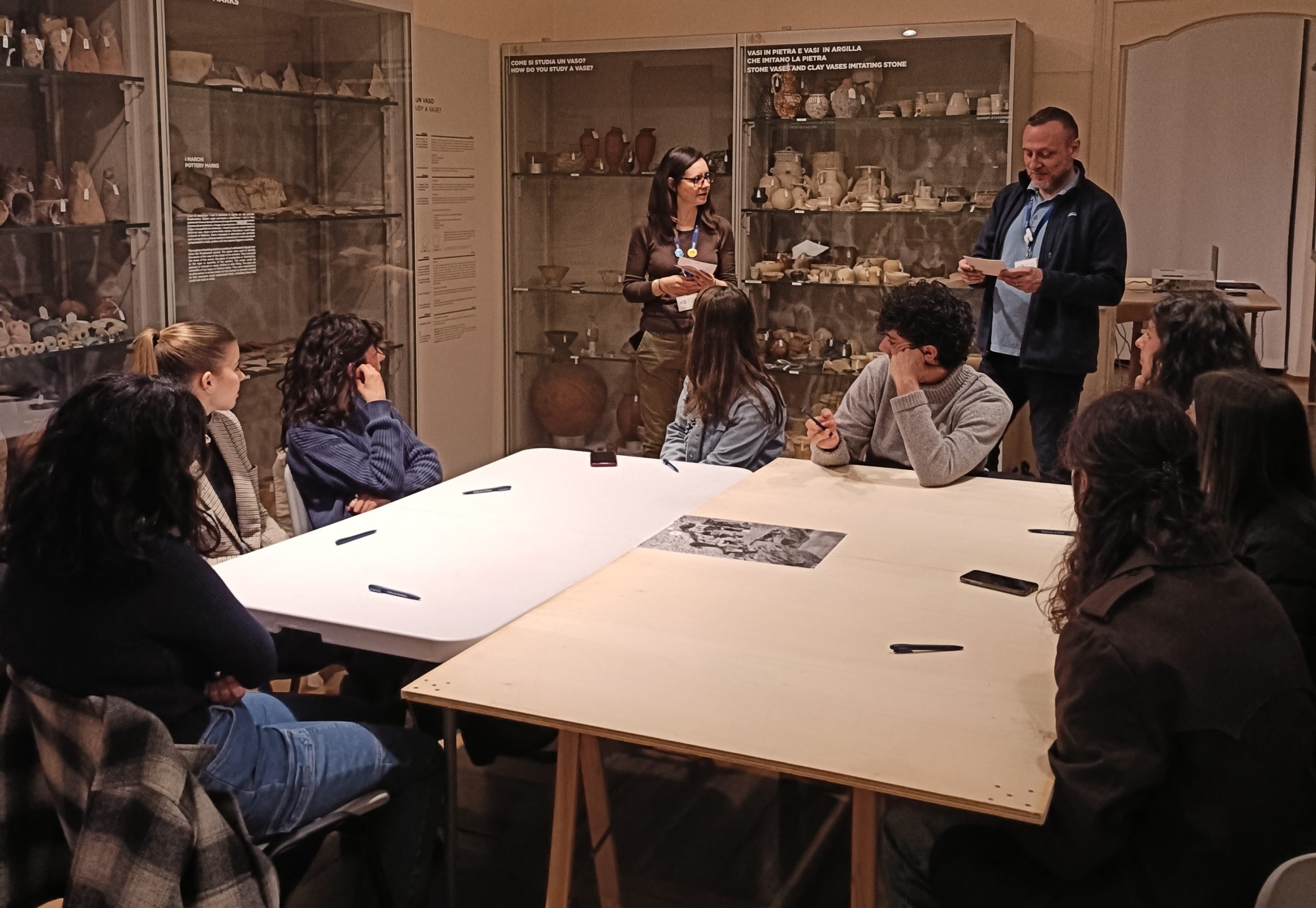
Inside the halls of the Museo Egizio, the team from Politecnico di Torino (POLITO) and museum curators teamed up to propose an interactive journey centred around historical photographs of Ernesto Schiaparelli’s excavations from the early 20th century.
Working with small groups of 15 to 20 people, the goal was to understand how the public connects emotionally and intellectually with the museum’s photographic archive.
Phase 1: Mapping Emotions with Keywords
The first activity invited participants to dive into a curated selection of 30 historical images chosen by the museum’s curators. Each participant was asked to select five images that resonated with them the most, and then rate their immediate emotional response.
Using simple color-coded stickers—green for positive responses, red for negative—applied to a personal sheet, participants also associated a maximum of three keywords with each image (Fig X). These sheets were later discussed openly with the curators, revealing recurring observations, unexpected connections, and shared perspectives between today’s public and these black-and-white windows into the past.
Phase 2: The Caption Game and Expert Dialogue
Next, the focus shifted to a specific archival image which was projected in the room to show an early 20th-century archaeological dig site. Here, the challenge became more fast-paced and collaborative. Each participant received a card and was given just one minute to complete two tasks:
- On the front: Write an instinctive caption for the photo (maximum 15 words) without any hints or prompts from the mediators.
- On the back: Formulate a direct question to the curator to uncover a curiosity or request more details.
Curators answered participants’ initial questions as concisely as possible, ensuring the group could move to the next phase without any outside influence. Following this brief introduction, the group collectively selected a single caption card from the pile. The card was then passed around the circle, allowing each participant to modify it by removing, replacing, or adding a maximum of two words. Once the collaborative text was complete, curators commented on the final caption and offered additional reflections on the collective work.
The activity concluded with an immersive viewing of the photographic plate. Curators conducted an in-depth analysis of the image, unveiling hidden details and sharing the photograph’s unique backstory and composition. By explaining its deeper heritage value beyond the physical object itself, the curators provided participants with further elements to reflect on the core messages and emotional content conveyed by the image.
Heroes and Identity at Alésia
Following the success of our activity at the Museo Egizio, our journey into co-creation and participatory research made its next stop in France, at the heart of MuséoParc Alésia. Here, participants involved in the measurement campaign were invited to step into the spotlight, becoming the protagonists of a little experiment in historical perception. While in Turin the common thread was archival photography, in Alésia we wanted to explore something even deeper: the intimate, and sometimes emotional, connection people hold with the great myths of the past.
Caesar vs. Vercingetorix: Choosing a Side
The activity proposed to participants was deceptively simple, yet rich in nuance. Each person was handed a card with a direct request: pick one of the two historical protagonists of the museum—Julius Caesar or Vercingetorix—place a sticker of their chosen character on the card, and write down a quality they particularly admired in that figure.
However, the real introspective journey was waiting on the back of the card. There, two mirror questions invited participants to look inward with a prompt as fascinating as it was provocative:
What of the ancient Gauls and Romans still resides in you?
What traces of their heritage do you feel are your own?
The public's verdict: courage, unity, and a pinch of historical rivalry
As might be expected on the historic soil of Alésia, the vast majority of participants aligned their hearts with the local hero, Vercingetorix. Only a small percentage—mostly consisting of younger participants—opted for the strategic allure of Julius Caesar. Once collected, the qualities admired by the audience were transformed into a dense word cloud. The result? For Vercingetorix, words like “courage” and, above all, “rassembleur”(unifier) emerged powerfully, proving that the Gallic leader is still viewed as a potent symbol of unity and resistance.
The quality you admire the most in… Vercingetorix (post-visit)

Unexpected reactions: when archaeology touches our identities
The most surprising and thought-provoking outcome of the activity emerged from questions regarding Roman heritage, which triggered a visibly friction-filled cultural response toward connections with the ancient Roman Empire. Far from remaining neutral, many participants actively expressed their discomfort. While some voiced their complaints directly to the research team, others chose to leave the question strictly blank, and several went as far as writing a definitive “Nothing” on their cards.
This unexpected reaction proves that ancient history is far from being just dust from the past; it remains entirely capable of igniting local identity and sparking incredibly lively debates. For META-MUSEUM, these spontaneous, visceral responses bring immense value to our research, serving as a powerful reminder that museums do not just house silent objects—they shelter the living, breathing roots of our modern communities